
Pneumatic Drive System [PDS] — [APDS]
Control the force applied to the membrane diamond anvil cell by varying the pressure in its membrane. The PDS200 is our own instrument, designed, machined and assembled in our workshops, self-contained and portable. The APDS is the same function driven by software, built around a Druck® or a WIKA® pressure controller.
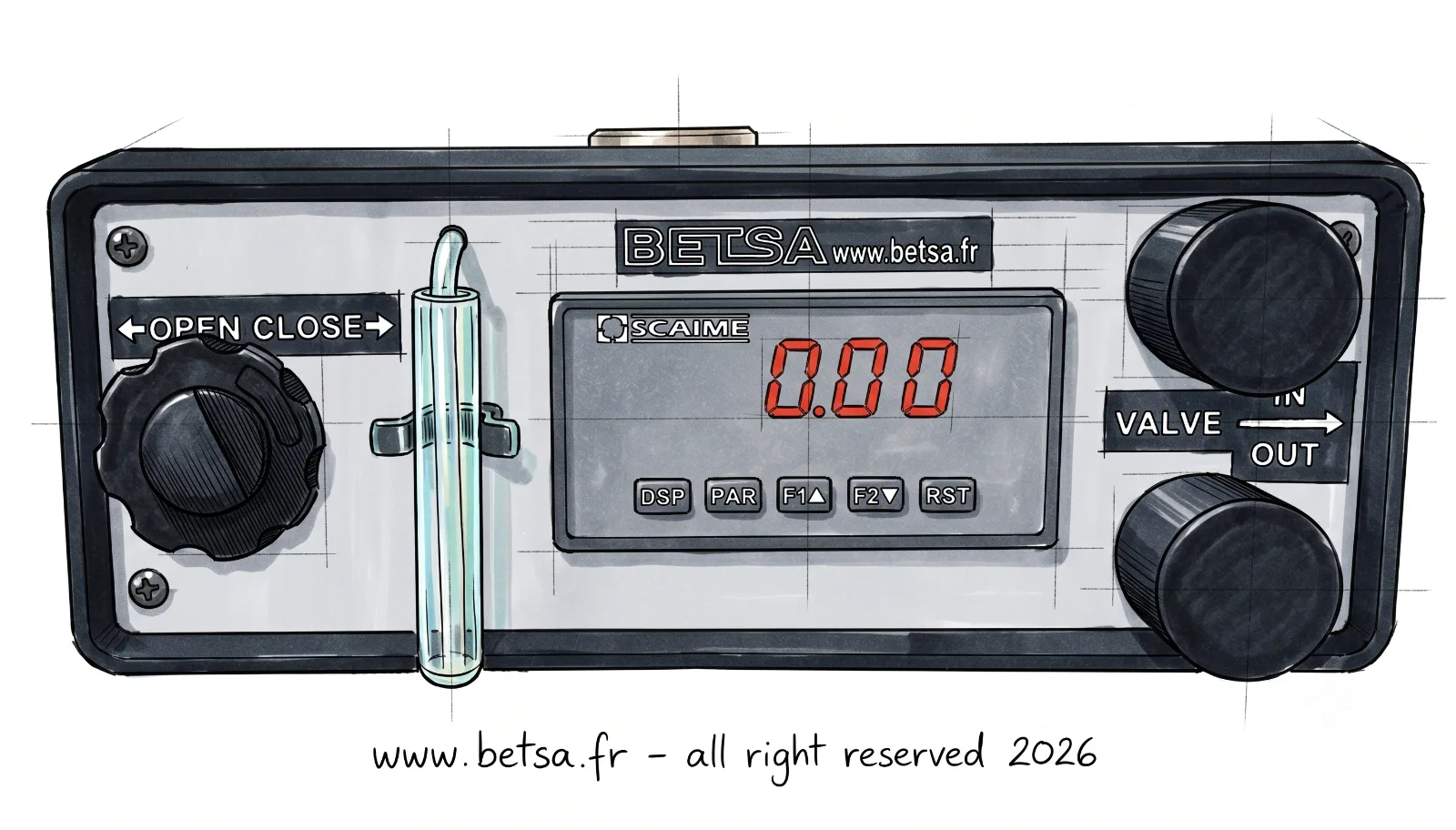
Manual — PDS200
The PDS200 is a BETSA® instrument. We designed it, we machine it, we assemble it, and we have been supplying it for more than twenty years without changing what works: two needle valves, IN and OUT, a purely mechanical regulation set finely and continuously, and a digital display reading the pressure applied to the membrane.
It carries its own gas. A 0.4 litre bottle filled with helium at 200 bar sits inside the case and allows many pressure cycles before reloading, so there is no gas line to plug in at the point of use. At 6.3 kg for 260 × 150 × 400 mm the instrument travels with the cell, from one hutch to the next and from the laboratory to a beamtime.
Nothing is programmed, so nothing becomes obsolete. There is no computer to connect, no software to install on a beamline machine and no driver to keep alive through operating system changes. Spare parts, servicing and repairs come straight from us, on a design that has not changed in more than twenty years.
The high pressure output on the rear panel is a Nova Swiss female fitting for 1/16” capillary; the loading connection is a ¼” Gyrolock female tube fitting.
Automatic — two controllers, one software
When the experiment calls for a numerical set-point, a controlled ramp or a script, BETSA® supplies the Automatic Pneumatic Drive System with two modular pressure controllers, and integrates either of them into a membrane DAC setup: the Druck® PACE5000 E and the WIKA® CPC4000. Both replace the manual needle valves of the PDS by an electronic regulation of the pressure applied on the membrane, both come with the BETSA® connections, and both are driven from the same BETSA® APDS Controller Software.
The choice depends on your bench. The PACE5000 E replaces the legacy PACE5000 chassis, keeps the same control modules, the same dimensions and the same SCPI commands, and is the more compact of the two in a 2U rack format; its interchangeable control modules bring the control accuracy down to 0.005 % of reading. The CPC4000 hosts up to two reference sensors in the same chassis, offers a larger seven-inch screen and covers vacuum as well, from −1 bar.
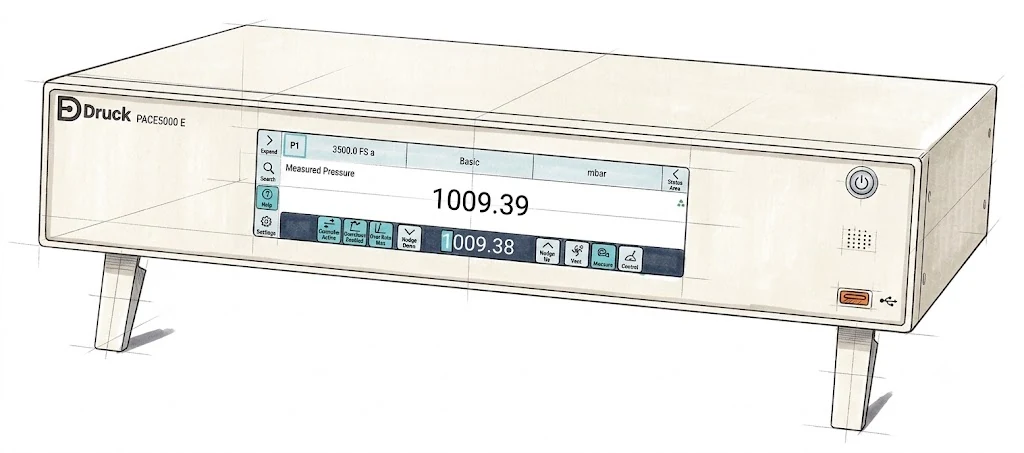
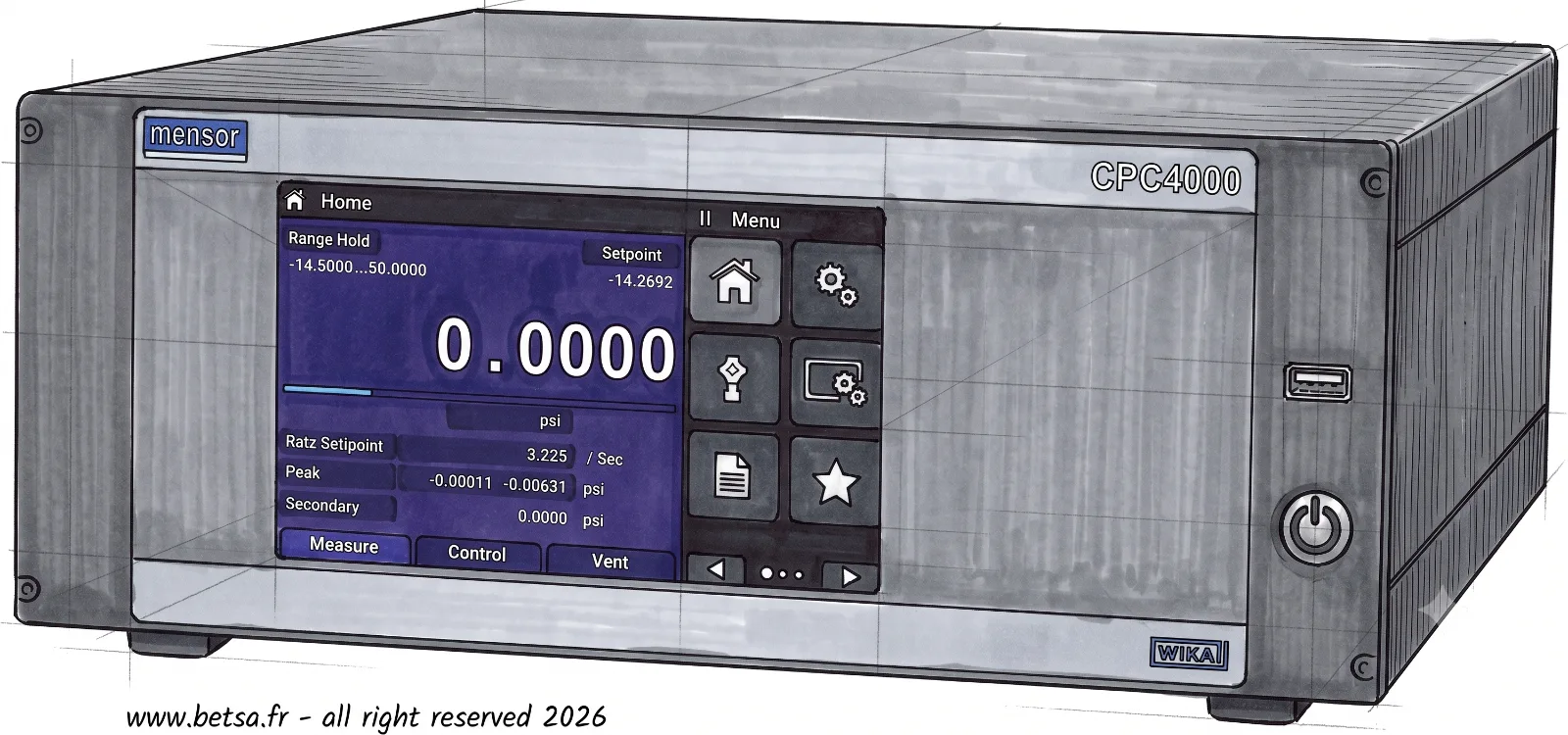
| Druck® PACE5000 EAPDS210 D | WIKA® CPC4000APDS210 W | |
|---|---|---|
| Manufacturer | Druck, Baker Hughes group | Mensor, WIKA group |
| Pressure range | Up to 210 bar gauge | −1 to 210 bar, vacuum included |
| Control accuracy | 0.02 % of reading as standard, down to 0.005 % with the CM2 module | 0.02 % IntelliScale-50 |
| Control stability | 0.001 % FS | < 0.005 % FS |
| Settling time | 1.5 s to a stable set-point | 10 s for +10 % in a 50 cc volume |
| Internal sensors | Interchangeable control module, one per channel | Up to two interchangeable reference sensors |
| Display | 4.3-inch colour touchscreen, icon-driven menu | 7-inch colour touchscreen |
| Connectivity | RS232, IEEE-488, Ethernet and USB as standard | RS-232, IEEE-488, Ethernet and USB as standard, Wi-Fi on option |
| Pneumatic connections | G1/8 female, rear panel | 4 × 7/16”-20 F SAE and 1 × 1/8” F NPT |
| Format | 2U rack, 44 × 32 cm | Desktop or 19-inch rack |
| Weight | 11 kg as supplied | About 12.7 kg |
| Power supply | 90–130 V and 180–260 V AC, 47–63 Hz | 100–240 V AC, 50/60 Hz |
| Internal helium bottle | None, external supply | None, external supply |
| Instrument driver | Certified LabVIEW plug and play, PACE5000 E and PACE6000 | SCPI command set |
Figures published by the manufacturers, for the configurations supplied by BETSA®. Tell us your pressure range and your bench, we will advise on the model.
The BETSA® APDS Controller Software runs on Windows 7, 8 and 10 over a USB serial converter, using the SCPI protocol. It displays the outlet pressure of the membrane and the inlet pressure of the helium bottle, and sets the set-point in bar.
- Overshoot — Fast reaches the set-point quickly and may go beyond it; Not allowed approaches it along an exponential curve.
- Slew mode — Linear follows a slew rate defined by the user; Max rate jumps instantly to the set-point.
- Slew rate in bar per minute or per second, depending on the unit set in the controller.
BETSA® can offer a solution adapted to your environment: with pneumatic components, we connect your laboratory equipment to the PDS.