[PRL] Pressure Ruby Luminescence
Optical Transfer
Choose and compose your own optical transfer according to your needs
Pressure Ruby Luminescence – Optical Transfer
1 — The ruby luminescence method
To measure the pressure in the experimental volume, a technique based on ruby luminescence is used. This method involves the use of a laser, usually green or blue in color, to excite a ruby ball inserted into the volume of interest. The pressure of the volume is then determined by analyzing the variation in the wavelength of the luminescence emitted by the ruby, which is directly influenced by the pressure exerted on it.
2 — The optical transfer
The observation of the experimental volume as well as the transfer of the laser and ruby beams are carried out by means of an optical transfer system, specifically a microscope. This optical transfer makes it possible to precisely visualize the experimental volume and to direct the laser and ruby beams towards the locations required to carry out the measurements. It also facilitates the transmission of the luminescence emitted by the ruby to the spectrometer.
3 — The BETSA® [PRL] spectrometer
In the context of this methodology, the spectrometer used is the BETSA® spectrometer [PRL]. It is integrated into the overall system and makes it possible to collect information on the luminescence of the ruby, by precisely analyzing the wavelength emitted. This spectral analysis provides the data necessary to calculate the pressure exerted on the experimental volume.
4 — Accuracy and fields of application
Using this approach, scientists can obtain accurate pressure measurements in the study volume, exploiting the luminescence properties of ruby. This method offers high sensitivity and high resolution, allowing reliable and accurate measurements in a given pressure range. It is commonly used in many research fields, such as high-pressure physics, geophysics, materials science, and many more.
In summary, pressure measurement by ruby luminescence is based on the excitation of a ruby ball using a laser, followed by the analysis of the variation in the wavelength of the luminescence emitted by ruby under pressure. This technique is made possible thanks to an optical transfer system, using a microscope, to observe the experimental volume and direct the laser and ruby beams towards the areas of interest. The luminescence data is then collected and analyzed using the BETSA® spectrometer to obtain precise pressure measurements.
How the pressure is measured
The optical transfer collects the light; the pressure itself comes from the position of a luminescence line. Open a chapter for the detail.
The physics in a nutshell
Ruby is an alumina crystal doped with chromium ions. Under laser excitation these ions emit an intense red luminescence made of two sharp lines, R1 near 694.3 nm and R2 near 692.9 nm.
Compressing the crystal modifies the crystal field around the ion: the doublet shifts to the red in a reproducible way, by about 0.365 nm per GPa near ambient. Measuring the position of R1 therefore measures the pressure — for fifty years the most widely used secondary pressure gauge in diamond anvil cells.
For measurements away from ambient temperature, resistive heating or a cryostat, the SrB4O7:Sm2+ borate sensor is offered as an alternative: its 685.4 nm line is almost insensitive to temperature, where the ruby line needs a correction.
Choosing a pressure scale
A pressure scale is a published calibration linking the line shift to pressure, established against a primary standard. Our software implements eight of them.
- Ruby: AIRAPT 2020, the international recommendation and the advised choice; Sokolova 2013; Dewaele 2008, quasi-hydrostatic helium up to about 150 GPa; Mao 1986 quasi-hydrostatic and Mao 1978 non-hydrostatic.
- Borate: Rashchenko 2015, Jing 2013 for non-hydrostatic media, and Datchi 1997 with its built-in correction above 500 K.
Below about 50 GPa all the ruby scales agree to better than 2 percent: what matters is quoting the scale used in your publications. Above that they diverge and the choice becomes significant.
Correcting for temperature
The ruby R1 line also shifts to the red as temperature rises, in the same direction as the pressure effect. Near ambient the sensitivity is about +0.00746 nm per kelvin, which biases the pressure by roughly 0.02 GPa per kelvin: an error of 50 K is worth about 1 GPa.
The standard published correction is applied symmetrically to the measurement and to the zero reference, so that just after a zero calibration the pressure stays exactly zero whatever the temperature — only the difference matters. Benches with their own temperature calibration can enter their own coefficients per temperature zone.
Uncertainty and hydrostaticity
Each reading carries an estimated uncertainty combining the uncertainty of the scale itself and the uncertainty on the line position, about half a detector pixel converted into GPa through the local slope of the scale.
This figure is an instrumental repeatability estimate, not a complete uncertainty budget: it includes neither the uncertainty of the entered temperature, nor the pressure gradients inside the cell, nor the departure from hydrostaticity of the transmitting medium — contributions the experimenter must assess.
Hydrostaticity indicator: fitting the R2 line separately gives the R1–R2 splitting, about 1.4 nm at ambient. Its evolution, together with the broadening of the lines, signals the build-up of non-hydrostatic stresses in the cell.
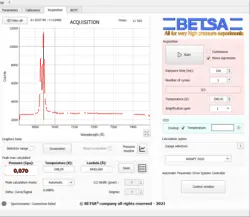
All of this is computed by BETSA® Soft PRL v4.00 — see the software and its manual →
Its small size and weight make “on site” measurements possible. When equipped with an internal mini laser it functions as a “stand alone” instrument.
Measurements are very easy and fast with custom high-pressure calculation software.
Components
Optical transfer
It is the mechanical basis useful for all optical transfers
- Optical transfer [TRANS]*
- XYZ Stage [XYZ3]
- V-block [V-BLOC]*
- The mounting bracket holds the [TRANS], with or without an XYZ stage.
Output signal
- Optical fiber (1 or 2 m) SMA to Ø5 [FIB02]
- Optical fiber (3 m) SMA to Ø5 [FIB03]
- Optical fiber (3 m) SMA to SMA [FIB03-SMA]*
- Optical fiber (4 m) [FIB04]
- Neon Source [NEON1]
- Other
Input Ruby Signal & Extension
Signal Ruby – entry and extension allows an offset of the whole assembly with the signal of the Ruby.
- Extension 50 mm [050 181]
- Extension 100 mm 90° [050 182]
- Extension magnification x 2 [050 1850]
Display
The display lets you watch the experiment, both during the measurement and during alignment.
- Eyepiece X10 [OCX10]
- Eyepiece X20 [OCX20]
- Fixed camera support [SCCF]
- Digital camera USB [CAM05]
Objective
- Objective X5 WD 35 mm [OBX5]
- Objective X10 WD 33.5 mm [OBX10]
- Objective X20 WD 20 mm [OBX20]
- Objective X50 WD 12.7 mm [OBX50]
Laser assembly
- Laser support [LF01]
- Laser shutter [OBT01]
- Laser support with fine tilt [LT01]
- Module for variable circular filter [PFR01]
Laser
- Blue laser 50mW 405 nm [D405-50D-CF]
Laser power supply
- Basic power supply [ALIM405]
- Power supply variable laser [ALIM405VAR]
- Power supply variable with display [ALIM405VAR-AFF]
- Power supply controlled by software [ALIM TRANS USB]
Monochromator spectrometer
- Pressure Ruby Luminescence BETSA® [MONO01]
- Monochromator Ocean Optics [OO4PRO]
Acquisition software
The optical transfer is driven by our own software: pressure calculated from the ruby fluorescence, spectrometer acquisition, and motorized control when the bench is equipped.
- BETSA® Soft PRL — for Hamamatsu® monochromator
- BETSA® Soft PRL 4000 — for Ocean Optics® spectrometer
- BETSA® Optical Transfer Controller [BOTC]
- BETSA® APDS Controller — pneumatic drive system
Compose your optical transfer
Download the PDF, then look on the following pages for the details of each component
You will be able to choose the parts of the optical transfer according to your needs, adapted to your experiments
Optical transfer base1 item
Mounting supports2 items
Input — ruby signal & extensions4 items
Objectives4 items
Laser assembly5 items
Display2 items
Output signal1 item
Laser & power supply5 items
Monochromator / spectrometer2 items
Your configuration 0 item
- Tick the parts you need — they will be listed here.
The laser is mounted on a fixed support with a tilt adjustment. This element, proposed by BETSA® with 250 µm/turn screws, allows a micrometric adjustment of this tilt, giving it an accuracy better than 5 µm.
Spectrometers
![BETSA® PRL [MONO01] Monochromator spectrometer – view 2](/wp-content/uploads/2026/07/betsa-pressure-ruby-luminescence-mono01.webp)
Spectrometer for high-pressure measurements — PRL [MONO01]
The PRL spectrometer (Pressure by Ruby Luminescence) has been designed for measuring pressures using the luminescence of a reference material (Ruby or SrB4O7:Sm2+). Its small size and weight make on-site measurements possible. Measurements are very easy and fast with custom high-pressure calculation software.
Features
- Detector with mobile diffraction grating — spectral range 675–739 nm, total mobility spectral range 616–760 nm
- Resolution: 0.1 nm (window aperture 200 µm)
- Sensitivity: 0.005 nm
- Pressure accuracy better than 0.05 GPa
- Highly stable temperature controller, cooling down to −10 °C
Standard items
- Plane grating, 600 lines/mm, third order, 49 cm²
- Achromatic doublet F = 160 mm
- Electronic interface sending the output signal to a computer through USB, read by dedicated high-pressure measurement software
![Monochromator spectrometer Ocean Optics [OO4PRO] – view 2 – BETSA®](/wp-content/uploads/2026/07/betsa-pressure-ruby-luminescence-oo4pro.webp)
Monochromator spectrometer — Ocean Optics [OO4PRO]
As an alternative to the BETSA® PRL, the optical transfer can be delivered with an Ocean Optics monochromator spectrometer.
It is connected to the output of the optical transfer by the SMA optical fiber [FIB02] / [FIB03], and is driven by its own acquisition software.
Detailed specifications on request.
Software
BETSA® Software Suite
The one item of our range that is not hardware: a single environment that drives the whole very high-pressure bench.
- Ruby fluorescence pressure measurement, with the published pressure gauges
- Automatic control of the pneumatic drive system
- Motorized optical transfer control
- Runs under Windows, supplied with your instrument