
ACCESSORIES
Ruby Balls
Corundum, chromium-doped alumina — Al₂O₃:Cr³⁺. In situ pressure calibration for diamond anvil cells.
The BETSA® ruby balls
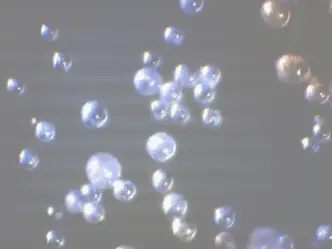
BETSA® has supplied the high-pressure community with ruby balls for in situ pressure measurement for over 35 years.
Our clients include synchrotron facilities such as the ESRF (Grenoble, France), SOLEIL (Saint-Aubin, France), PETRA III at DESY (Hamburg, Germany), ALBA (Barcelona, Spain), Elettra (Trieste, Italy) and Diamond Light Source (UK), and institutes such as the CEA and the CNRS (France), LLNL (Livermore, USA), HPSTAR (Beijing, China) and the IMPMC (Paris, France).
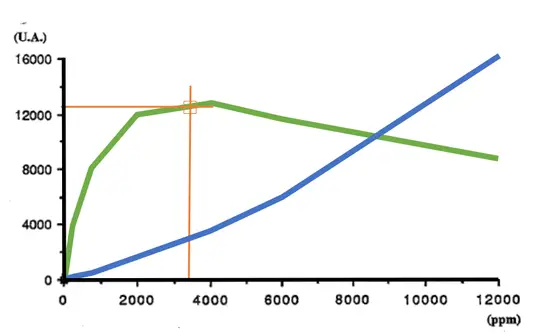
The chromium doping of 3300 ppm is constant and optimal for obtaining the highest R1 line intensity, so as to measure the highest possible pressures for a given laser wavelength.
Typically, BETSA® ruby balls allow you to measure pressures as high as 90 GPa using a 532 nm laser at 10 mW, and up to 120 GPa using a 405 nm laser at 50 mW.
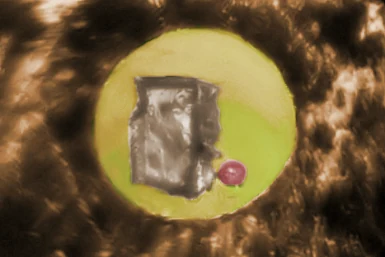
BETSA® delivers its ruby balls on a holder that makes them safe and easy to carry, to observe under a microscope and to pick up individually so as to place them inside a DAC. The 10 mg quantity we propose is ideal for not saturating the holder while keeping it convenient. This 10 mg corresponds to several thousand balls, so a single holder provides a high-pressure laboratory with the ruby balls it needs for many years.
How they are made
Their sphericity arises from their preparation method: molten doped alumina is pushed through a jet so that small droplets form and solidify while “in flight”. Unlike crushing large pieces of ruby, this method provides single-crystalline spheres with little internal stress, free of dislocations and featuring a smooth, non-scattering surface. To remove any remaining internal stress, we heat-treat our ruby balls several times. This way, our ruby balls provide clear and narrow R1 and R2 fluorescence lines — the R1 line FWHM is typically 0.7 nm.
The spherical shape is also a guarantee in itself: a perfect sphere seen under the microscope tells you that what you have loaded really is a ruby ball, and not a fragment of some random substance.