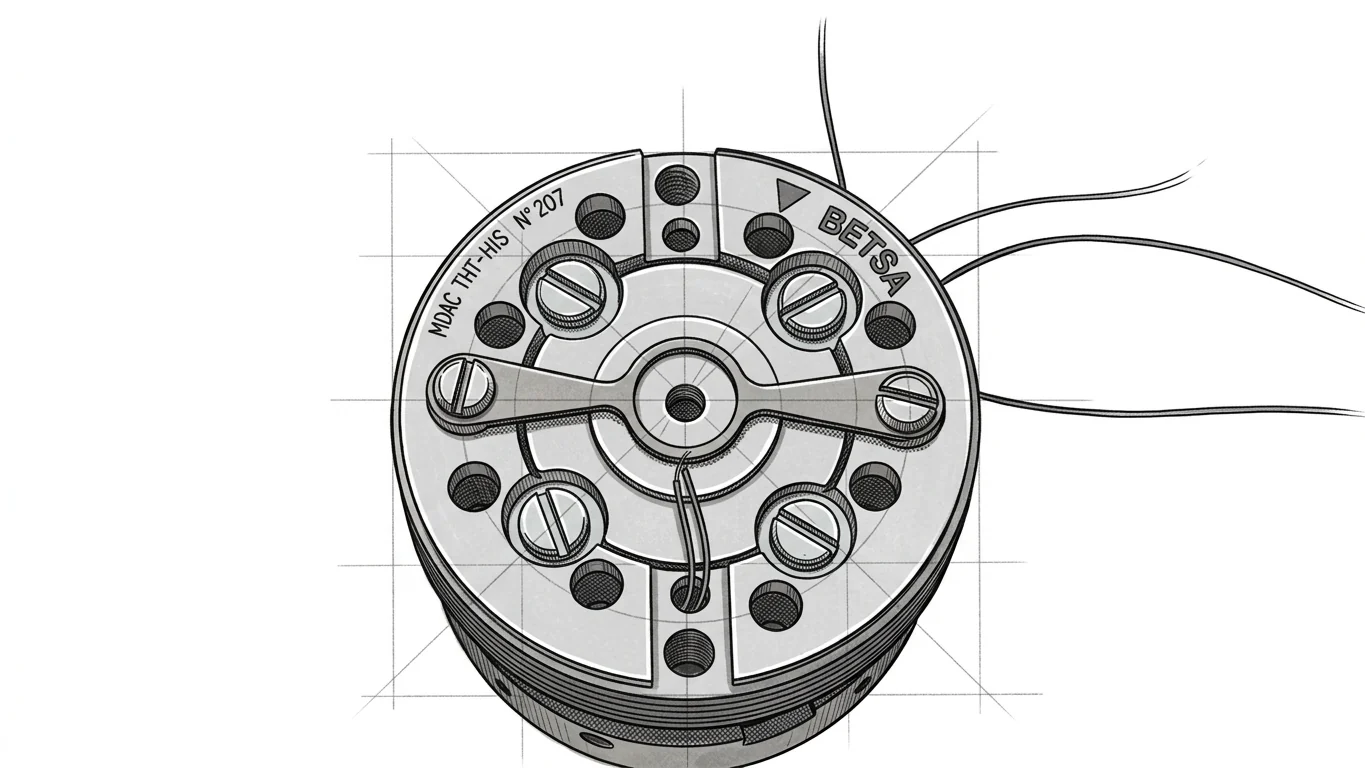
Internal Heating System [IHS01]
An internal stage for the BETSA® M-DAC, reaching 1450 °C continuously in air, gas or vacuum. Used on its own or together with the external heating system.
The system
BETSA® has developed an internal heating system that reaches 1450 °C continuously, in air, gas or vacuum. It is an internal stage of the BETSA® M-DAC and works on its own or alongside the external heating system, which heats around the cell.
The resistor is made to your requirement — 3D printed, laser cut or machined — so it can be tailored to your anvil size and shape and to your seal material, and special sizes can be studied on request. It ships with two type K thermocouple probes: one soldered directly to the resistor to control the highest temperature, one to be glued on the anvil to read the in-situ temperature.
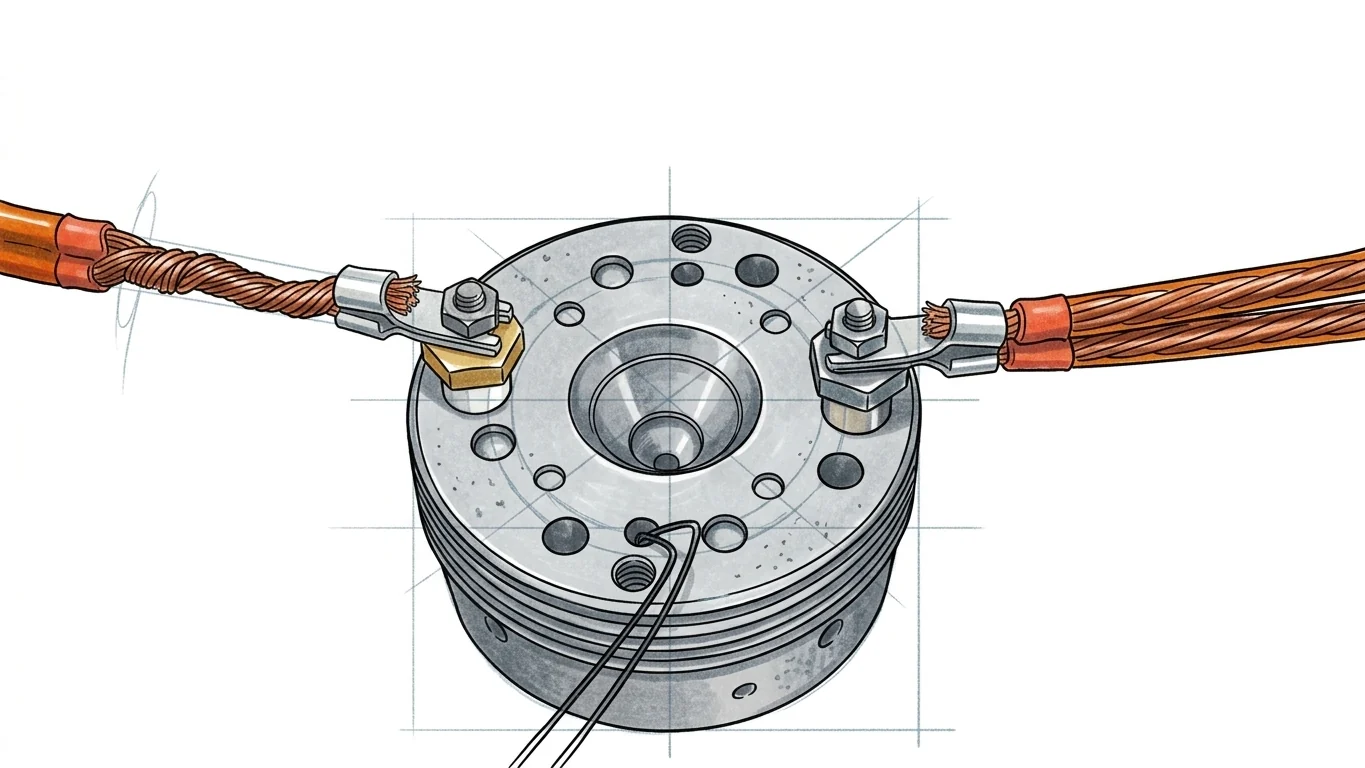
- Connections by external double 13 AWG wire, 2 × 2.5 mm².
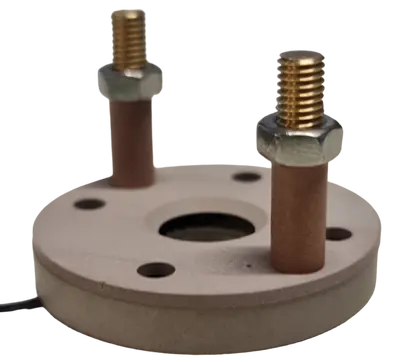
- Pyrophyllite insulator body, output spacing 34 mm, Ø6 mm — standard on BETSA® cells. On another cell, the spacing, the insulator size and their position are adapted to the design.
- Regulation precision depends on the environment: air, gas or vacuum.
![BETSA® Internal Heating System [IHS01]](/wp-content/uploads/2026/07/betsa-ihs-internal-heating-system.webp)
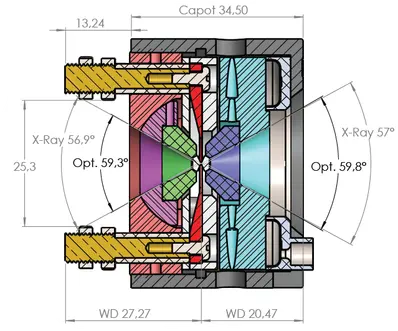
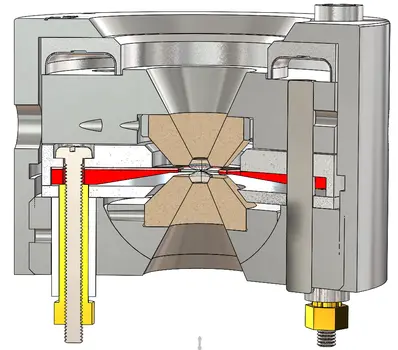
Inside the cell — M-DAC-XCV-THT-IHS
The IHS is hosted by the M-DAC-XCV-THT, a membrane diamond anvil cell built for extremely high temperature. Optical apertures reach close to 60 degrees, X-ray apertures are symmetrical at 57 degrees.
The assembly is plug and play: it is fitted and removed inside the cell with standard fittings for the external power supply and for the internal temperature monitoring.
The cell shown here is an example fitted with an insulator: it keeps the heat from spreading towards the outside of the cell. The heat stays concentrated inside, held by the insulator and the ZrO2 seats.
The element itself
The part that decides everything
Internal heating puts the heat where the experiment is: a resistive element inside the cell, around the gasket, rather than an oven warming the whole body from outside. The sample reaches temperature quickly, the cell stays comparatively cool, and the thermal gradient sits where it is wanted.
These elements are 3D printed, laser cut or machined, depending on what the design calls for. We work all three techniques ourselves, which means the manufacturing route follows the drawing instead of the drawing following the machine.
And the drawing follows the experiment. The design depends on the cell, on the temperature you want to reach, and on the gasket itself: its shape, its material and its thickness.
An example. An internal element running at 1370 °C brings a square gasket of 5.2 × 5.2 × 0.200 mm to 900 °C, and a round gasket of Ø 4 mm to 1200 °C. The geometry of the gasket alone accounts for three hundred degrees.
Other designs exist for larger gaskets, Ø 10 and Ø 14 mm, in stainless steel or in rhenium.
To date, every element has been driven with at most 60 A at 2 V — about 120 W. That power has never been exceeded on our benches: reaching 1400 °C on the resistive element stays within this limit, and the equipment BETSA® supplies does not call for more.
Every element is drawn for the job it has to do. Tell us the cell, the temperature you are aiming for and the gasket you use, and we will tell you which design fits — or draw the one that does.
Another option
Also built without insulators
Elements are also made without insulators, mounted directly around the gasket. The two views below show a cell assembled this way.